





Miss This? Fleet Meets: Eric Kilgore
Geotab Study Finds $105M Opportunity in Reducing Fleet Idling
A study of more than 2.6 million commercial vehicles found that targeting the worst-performing fleet vehicles could save 24.2 million gallons of fuel annually.
August 21, 2026
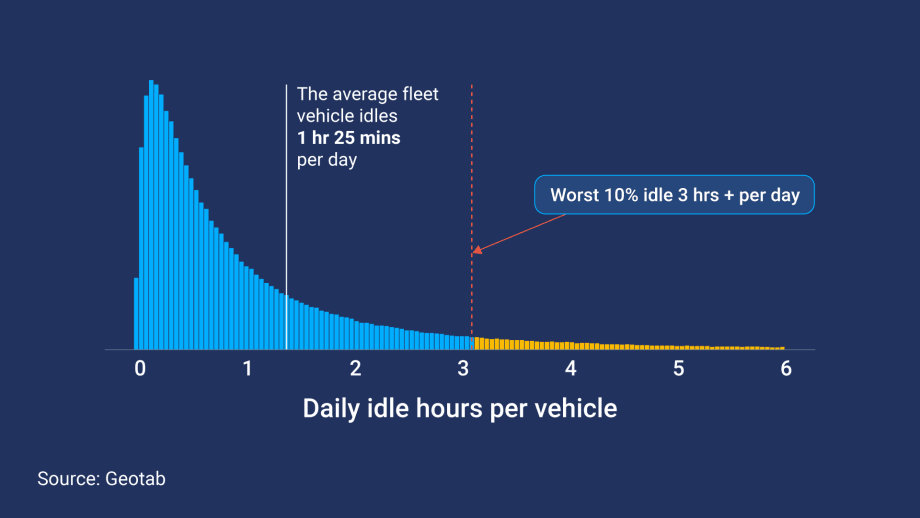
Geotab’s analysis found a wide gap in commercial vehicle idling, with the average vehicle idling 1 hour and 25 minutes per driving day, while the worst-performing 10% idle for more than three hours.
Credit:
Geotab
3 min to read
Commercial fleets in the U.S. and Canada could save an estimated $105 million in annual fuel costs by reducing excessive idling among their worst-performing vehicles, according to a new Geotab analysis.
Geotab analyzed idling behavior across more than 2.6 million connected commercial vehicles over 12 months from June 2025 through May 2026.
The study found that the average commercial vehicle idles for about 1 hour and 25 minutes per driving day, consuming 0.95 gallons of fuel in the process.
However, the median vehicle idles for 41 minutes or less, indicating that a relatively small group of heavy idlers is pushing the overall average higher.
Vehicles in the worst-performing 10% idle for more than three hours per driving day and consume more than 2 gallons of fuel during that time.
Targeting Fleet Idling Could Save Millions
Rather than assuming fleets can eliminate idling entirely, Geotab compared vehicles against peer groups based on vocation, vehicle type, and weight class.
They identified approximately 261,000 vehicles in the worst-performing 10% of those peer groups.
If those vehicles reduced their idling to the median performance of comparable vehicles, Geotab estimates fleets could save 24.2 million gallons of fuel annually.
Based on average gasoline and diesel prices during the first half of 2026, that represents approximately $105 million in annual savings, or roughly $400 for each underperforming vehicle.
The approach recognizes that the appropriate amount of idling can vary significantly depending on how a vehicle is used.
How Fleets Can Identify Preventable Idling
One of the study's central findings is that high idle time does not necessarily indicate poor fleet performance.
For fleet managers, Geotab recommends first establishing a baseline by examining idle hours per driving day, idling as a share of total fuel consumption, and idle time relative to total engine-on time.
Fleets can then separate operational idling from discretionary or avoidable idling.
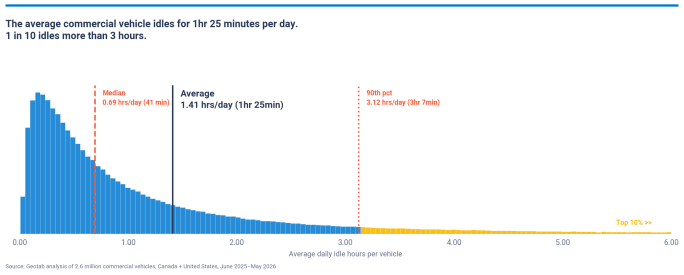
Analysis of 2.6 million commercial vehicles in Canada and the United States.
Credit:
Geotab
Power take-off activity is one example of operational idling. Still, other legitimate uses can include drivers using the vehicle for administrative work or rest while relying on in-cab climate control.
For avoidable idling, Geotab recommends looking first at driver behavior.
“Driver behavior is usually the first lever for the discretionary portion,” said Charlotte Argue, senior manager of sustainable mobility at Geotab and author of the analysis.
Driver coaching, telematics-triggered alerts, clear idling policies, and performance recognition programs can provide opportunities to reduce unnecessary engine hours without requiring additional capital investment.
For operational idling, fleets can instead determine whether the main engine needs to provide the required power.
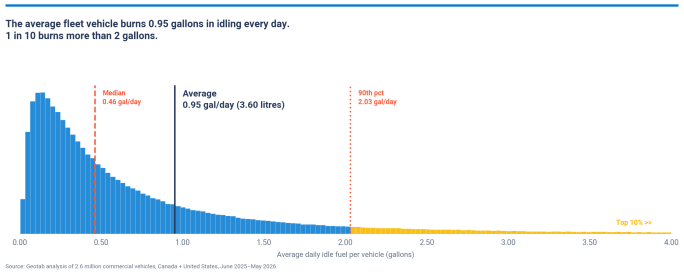
Analysis of 2.6 million commercial vehicles in Canada and the United States.
Credit:
Geotab
Auxiliary power units, electric PTO systems, and vehicle-mounted power systems can potentially operate climate control, communications equipment, and vocational equipment without keeping the vehicle's main engine running.
Those technologies could be particularly applicable to high-idle applications including public safety, utilities, and construction.
Ultimately, the study suggests fleets may see better results by targeting specific vehicles and operating conditions rather than implementing blanket idle-reduction goals.
Instead of simply asking how much their vehicles idle, Argue said fleet operators should consider another question: “Which idling is actually worth targeting?”
Topics:Vehicle Research
More Vehicle Research

Chevrolet Updates 2027 Trax and Trailblazer with More Standard Safety Features
Chevrolet is updating two of its smallest SUVs with added driver-assistance technology, redesigned interiors, and revised trim options. The changes could add more safety equipment as standard for commercial fleets, while a new Trailblazer configuration adds another all-wheel-drive option.
Read More →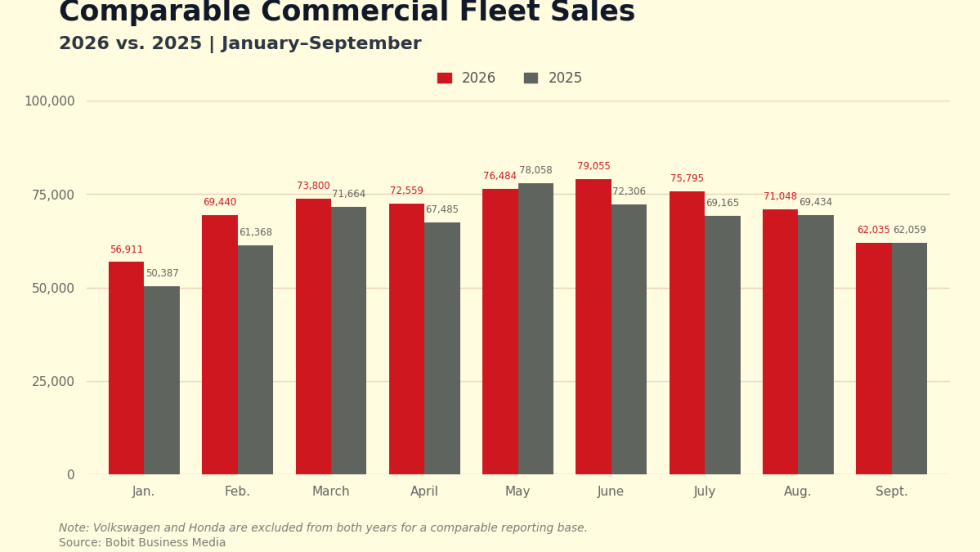
Commercial Fleet Sales Rise 5.8% Through September 2026
September commercial fleet sales were essentially unchanged from a year earlier, slowing year-to-date growth while keeping volume ahead of 2025.
Read More →
Hall of Fame Inductee: John Dmochowsky
The longtime Mondelēz International fleet executive joins the Automotive Fleet Hall of Fame.
Read More →
Hall of Fame Inductee: Lee Miller
After more than four decades at Boehringer Ingelheim, Lee Miller leaves a legacy built on fleet expertise.
Read More →
Hall of Fame Inductee: Mark F. Petersen
From managing fleets of thousands of vehicles to advancing safety and mentoring fellow professionals, Mark F. Petersen made his mark across both the corporate and supplier sides of fleet.
Read More →
When Charger Downtime Becomes a Fleet Availability Problem
As EV deployments move beyond pilot programs, charger reliability can directly affect vehicle readiness, driver productivity and route scheduling.
Read More →
2027 Nissan Rogue Hybrid Adds e-POWER, Standard AWD
The new Rogue Hybrid uses Nissan’s e-POWER system with dual electric motors, offers an estimated 40 mpg and starts at $35,490.
Read More →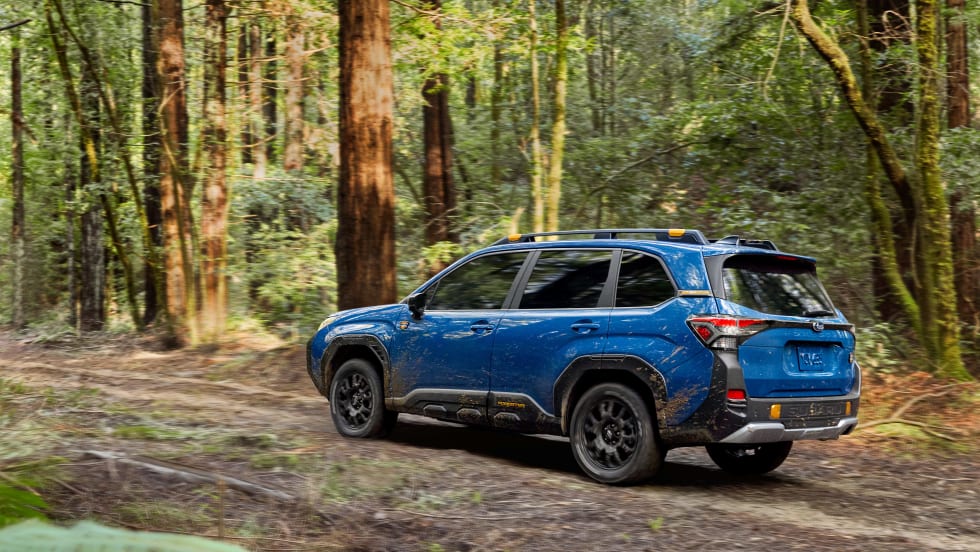
2027 Subaru Forester Adds First Wilderness Hybrid
The 2027 Forester lineup starts at $29,995 and adds a Wilderness Hybrid with 194 combined horsepower and 9.3 inches of ground clearance.
Read More →
EV Realty Names Henrik Holland President as Charging Platform Expands
The former Prologis Mobility and Shell executive will help expand EV Realty’s truck charging business and move its power-first infrastructure model into autonomous vehicle depots and other fleet sectors.
Read More →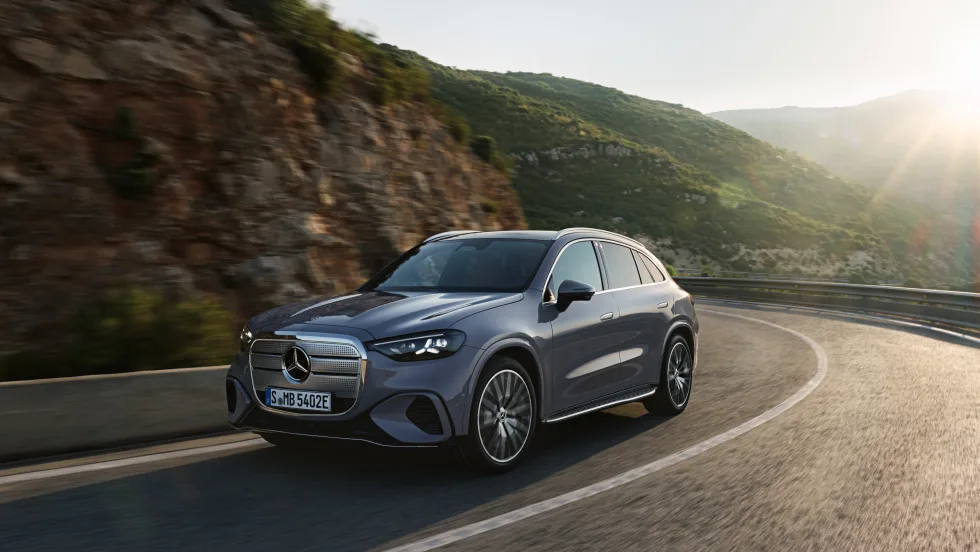
Mercedes-Benz Introduces Electric GLC With Up to 350 Miles of Range
The GLC 400 4MATIC Electric features an 800-volt architecture, 330-kW DC fast charging and a 94-kWh battery, along with Mercedes-Benz's new MB.OS operating system.
Read More →